
You were driving along when the engine simply quit. No warning light, no long goodbye, just a sudden loss of power and a silence that feels expensive. When you try the key, the starter spins freely, faster than usual, but the engine never catches. A tow driver or a mechanic mentions the words “timing belt,” and now you’re asking yourself who would ever want this car.
Plenty of people do. A broken timing belt or chain is serious, but it doesn’t automatically make your car or truck dead, and it doesn’t make it worthless. Sometimes, the repair is easier than you might expect. In others, it isn’t worth doing, and buyers who work with mechanical trouble will still make an offer. This guide explains what happened, how to find out how bad it is, what repair costs and how to get paid. We work with sellers across the whole country, so these steps apply wherever you live.
How Does a Timing Belt or Chain Keep the Engine Running?
Your engine’s crankshaft turns the pistons. Its camshafts open and close the valves. The timing belt or chain links the two, so the valves move at exactly the right moment in every cycle. If that link breaks, the engine loses its rhythm and stops.
Belts and chains differ in a few ways:
- Timing belts are reinforced rubber. They’re quiet and light, but they wear out and need replacing at set intervals, often somewhere between 60,000 and 100,000 miles. Your owner’s manual lists the schedule.
- Timing chains are metal, like a bicycle chain. They typically last longer, but the chain can stretch over time, while its guides and tensioners may gradually wear down.
- Is this conversation helpful so far?
Either one can fail, and what happens next depends on the type of engine you have.
What Occurs When a Timing Belt or Chain Fails?
The engine stops almost immediately, because the camshaft is no longer turning with the crankshaft. Typical signs after a failure:
- The engine quits suddenly, often at speed
- The starter turns the engine over easily and quickly, with no resistance
- The engine won’t start, and the check engine light may come on
- Sometimes there’s a loud bang, clatter or snapping sound beforehand
Stop trying to start it. Repeated cranking can add damage, and on some engines it does nothing at all except drain the battery. Have the car towed to a shop or, if you’ve decided to sell, simply arrange pickup.
Is Your Engine Interference or Non-Interference?
This is the single most important question, and it decides whether your car is a minor repair or a major one.
Non-interference engines. The valves and pistons never occupy the same space, so when the belt breaks, nothing collides.With the right parts and adjustments, the engine may be restored by replacing the belt and water pump. The bill is modest, and the car may run fine afterward.
Interference engines. The pistons and valves move through the same area at separate times. If the engine loses timing, they may strike each other. Bent valves, damaged pistons, a cracked head or worse can follow. Repair gets costly.
Most newer engines use an interference design, although some are built differently. A mechanic can look up your engine, inspect the valves and run a compression test or use a small camera inside the cylinders to see what happened. You don’t need to guess, and you shouldn’t assume the worst without checking. If you can’t get a diagnosis, say so when you request an offer, and we’ll price the car with the damage risk in mind.
Is a Car With a Broken Timing Belt Really Dead?
No. Think of it as a range:
Best case.A snapped belt in a non-interference engine. Replacement gets it running again.
Middle case. An interference engine with several bent valves. A cylinder head repair may be enough, though it isn’t cheap.
Worst case. Damaged pistons, a cracked head or a destroyed engine that needs replacement, which can cost more than the car.
Even in the worst case, you still own a vehicle with a body, frame, wheels, a transmission and plenty of metal. A buyer who works with mechanical failures prices all of that, and that’s why selling a car with a broken timing belt is usually possible.
What Should You Do Right Away?
- Don’t crank the engine or try to jump-start it.
- Get the car off the road and arrange a tow.
- Gather your records. If the belt was replaced recently, receipts can matter for warranty claims or for buyers.
- Check your warranty. Some belts or services are covered, particularly on newer vehicles or after recent work.
- Ask for a proper diagnosis if you’re considering a repair. The answer to “interference or not” is worth having.
- Photograph the car and the engine bay if it’s safe.
How Does a Mechanic Check for Damage?
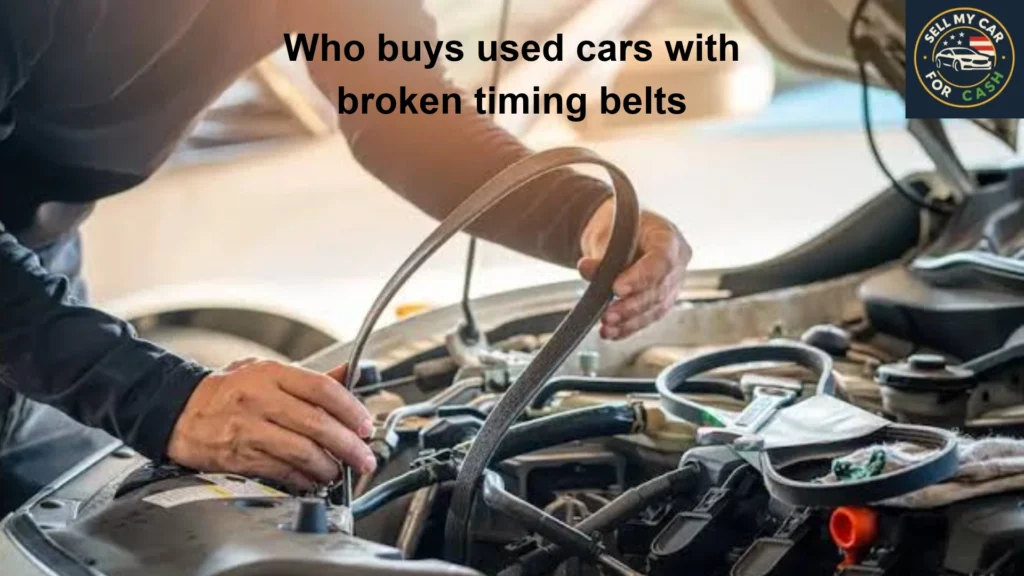
A shop has a few simple ways to see what happened without taking the engine apart. They can remove the timing cover or a valve cover to look at the belt or chain and see whether the camshaft turns when the crankshaft does. A compression test shows whether the cylinders still hold pressure, and low or uneven numbers point to bent valves or worse. A leak-down test pinpoints where the pressure escapes. A small camera, called a borescope, can look inside a cylinder through the spark plug hole for piston or valve damage.
These checks usually cost far less than a repair, and they turn a guess into a plan.
Could It Have Been Prevented, and Does It Matter?
Often, yes, and it may matter more than you’d expect. Belts fail from age, wear, oil leaks that soak the rubber, a failing tensioner or a water pump that seizes. Chains fail when oil changes are skipped, tensioners wear or the chain stretches over time.
If the belt broke well before its scheduled replacement, a defective part or a recent repair done badly may be to blame, and a shop’s warranty may apply. If it broke long after it was due, the cause was likely age. Either way, you can sell the car. But if you suspect a faulty repair, keep the paperwork and ask the shop.
What Warning Signs Come Before a Belt or Chain Fails?
If you’re reading this about a car that hasn’t failed yet, these signals deserve attention:
- A ticking, whirring or squealing noise from the front of the engine
- A rattle on cold starts that fades as the engine warms, common with stretched chains
- Oil leaking near the front of the engine, which can soak a belt
- A check engine light with codes about camshaft or crankshaft correlation
- Rough idle, misfires or a loss of power
- Mileage or age past the service interval, even if the car runs well
The cheapest repair is replacing a belt on schedule. If you’ve inherited a used car with no service history, treat the belt as overdue until a mechanic says otherwise.
What Is a Wet Belt, and Why Does It Matter?
Some engines use a belt that runs inside the engine, bathed in oil. These “wet belts” can degrade with age, and bits of rubber can clog the oil system, which starves the engine of lubrication and causes damage that goes beyond a broken belt. Oil changes at the right intervals and the correct oil type matter on these engines.
If your vehicle has a wet belt, tell the buyer, and describe what the shop found. It affects the repair cost and the price.
What Does Repair Cost?
It depends on which of the cases above applies. As rough guides:
- A new timing belt, with water pump and tensioner: often $500 to $1,200, sometimes more on larger engines
- A timing chain and guides replacement: often $1,500 to $3,000 or more, since labor is heavy
- A cylinder head repair after bent valves: commonly $2,000 to $4,500 or more
- A replacement engine: commonly $3,000 to $7,000 or more
Those numbers vary by region, vehicle and shop, and they don’t include towing, a rental car or the time the car sits in the shop. Get the diagnosis in writing before you compare them with the car’s value.
Should You Fix It or Sell It?
Three questions help:
- What’s a car worth running? If the repair costs more than about half of that, fixing it rarely pays off.
- Is it an interference engine, and was there damage? A cheap belt replacement is a very different decision from a bent-valve repair.
- How long will you keep the car? A car you love, with low miles, can justify a repair. An older car at the end of its life usually can’t.
Before deciding, look up your VIN at nhtsa.gov/recalls and ask the manufacturer about extended coverage. Some engines have known timing issues.
Who Buys Used Cars With Broken Timing Belts?
Your options come down to who sees value in the car as it is:
- Dealers. Some take a trade-in with mechanical trouble, but the offer reflects the risk, and many pass.
- Private buyers. Mechanics and DIY owners sometimes want a project, especially if the engine might be non-interference. Expect haggling, strangers at your door and the need to disclose the failure.
- Scrapyards. They pay for metal weight, often expecting you to handle the tow.
- Direct buyers like us. We price the whole vehicle, running or not, send a tow truck at no charge and handle the paperwork. Our cash for junk cars page explains how we think about older vehicles.
If you want the simplest route, a direct buyer is hard to beat. And if a mechanic has confirmed a non-interference engine, tell us. A simple belt fix can raise the offer, since the car is easier to resell.
How Much Cash Can You Get for a Car With a Broken Timing Belt?
No honest buyer can name a final number without knowing the car. In general, cash for cars with broken timing belts ranges from a few hundred dollars for an older, high-mileage vehicle to a couple of thousand dollars or more for a newer, clean, in-demand model. Those are ballparks, not promises. What moves the number:
- Make, model and year. Popular models hold value. Browse our car models page.
- Engine type and damage. A non-interference engine is priced differently from one with bent valves.
- Overall condition. Body, glass, wheels, interior and transmission all count.
- Missing parts. A missing catalytic converter or battery reduces the offer.
- Weight and scrap prices. Metal value changes over time.
- Paperwork. A clean title keeps things simple.
The surest way to see your number is to describe the car honestly through our instant offer form. Include whether the belt or chain broke, when it last changed and what a mechanic told you.
Do You Have to Tell the Buyer About the Failure?
Yes, and it works in your favor. Hiding a known engine problem can create legal trouble in a private sale, and the rules vary by state. With a professional buyer, honesty simply keeps the offer firm. We price the car based on what you tell us, and when the car matches your description, the offer holds at pickup.
What About Trucks and SUVs?
Trucks and SUVs hold value even when the engine fails. Their frames, drivetrains and bodies are worth something. Their engines can also be larger and more complex, so repairs often cost more. Diesel engines and some V6 and V8 designs can be especially expensive. Tell the buyer about towing packages, lift kits and modifications, and describe exactly what the mechanic found.
What Do Real Situations Look Like?
Here are three typical ones. They’re composites, not customer stories, but they show how decisions tend to go.
The lucky one. A driver’s older hatchback loses its belt on a country road. The mechanic confirms a non-interference engine, replaces the belt and water pump and the car runs fine again. Selling wasn’t necessary.
The bent valves. A commuter sedan with 140,000 miles snaps its belt on the highway. The engine is an interference design, and the valves are bent. The repair costs more than the car is worth, so the owner takes a cash offer instead.
The chain that stretched. A pickup rattles on cold starts for months before the timing chain jumps a tooth. The repair is large, and the owner decides to sell the truck as is rather than gamble on more problems.
In each case, an honest diagnosis made the choice clear.
How Does the Sale Work?
The process is short, and the car doesn’t need to run.
- Share your car’s details. Year, make, model, condition, ZIP code and what happened to the engine.
- Review your offer. It’s based on your actual vehicle, and there’s no obligation.
- Choose a pickup time. Same-day pickup is often possible depending on where you live. We arrange towing in all 50 states and cover the cost.
- Hand over the paperwork. The driver confirms the car matches your description, and you sign the title and bill of sale.
- Get paid. Payment follows when the car leaves.
Our free car removal page covers towing in more detail.
What Paperwork Do You Need?
You’ll need the title in your name, a photo ID and a bill of sale. If you still owe money, your lender holds the title and you’ll need a payoff figure. Our FAQ page answers questions about selling with a loan. If the title is missing, see our guide to cash for cars without a title. Many states also provide a release of liability form, so check yours.
What Mistakes Should You Avoid?
A few common ones cost people money:
- Cranking the engine again and again. It can add damage and rarely helps.
- Assuming the worst before a mechanic checks whether it’s interference.
- Paying for a full teardown before you know the repair is worth it.
- Hiding the failure from a buyer.
- Waiting months. The car keeps losing value while it sits.
- Signing the title before you’re paid.
Why Choose to Sell My Car for Cash?
We buy cars and trucks in any condition, running or not, with a title or without one. Your offer is based on your actual vehicle, towing is free and we serve all 50 states. Questions are welcome at (888) 781-2436, so ask about pricing, paperwork or timing before you decide. An offer costs nothing to request, and there’s no pressure to accept it.
FAQs
Can I sell a car with a broken timing belt?
Yes. A broken timing belt lowers the price but doesn’t make the car unsellable. Buyers of vehicles with engine trouble expect it and price it in.
Is a car with a broken timing belt dead?
Not necessarily. On a non-interference engine, a new belt may get it running again. Even serious damage leaves a car with value.
How much is a car with a broken timing belt worth?
It depends on the year, make, model, condition and how much damage the engine suffered. An instant offer is the quickest way to see your number.
Do I pay for towing?
Not with us. Pickup is free in all 50 states. With other buyers, ask about towing and admin fees before accepting.
Who buys used cars with broken timing belts?
Dealers, private buyers, scrapyards and direct buyers like us. If the repair isn’t worth it, a direct buyer is usually the simplest choice.
Does a broken timing chain work the same way?
Mostly, yes. A broken or jumped chain can also cause serious engine damage, and we buy those cars too. The repair is often larger, which makes selling more attractive.
Ready for Your Offer?
A broken timing belt or chain is a setback, not the end of your vehicle’s value. Find out what kind of engine you have, weigh the repair cost and compare your options. Whatever you decide, a quick diagnosis keeps you in control. If selling is the better path, request your price through our instant offer form and we’ll arrange the rest.